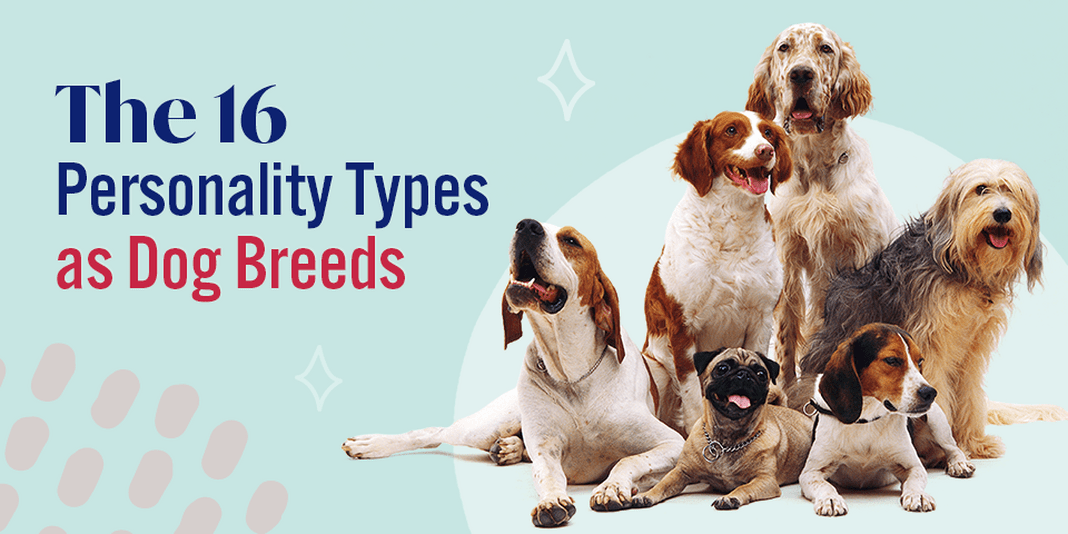
The 16 Personality Types as Dog Breeds
I was walking my dog the other day, watching this cute little sheriff barking away at every pedestrian, dog and cyclist that happened to find its way onto her beach. I shook my head and laughed: “She really does think she runs this place.” Like an ESTJ, I thought.
And once the idea popped into my head, I couldn’t unsee it. Every dog breed suddenly started looking like a Myers-Briggs personality type: the Golden Retriever greeting complete strangers like long-lost friends, my friend’s Jack Russell tirelessly trying to tunnel into another dimension, the Border Collie staring into the distance and knowing only he could save humanity.
Of course, every pet has their own character, but dog breeds come with predictable temperaments that sometimes feel uncannily familiar. Because when I look at my dog arguing with me about wearing a coat on a rainy day, she seems less like an animal and more like a tiny, furry, stubborn person. And if dogs can have personalities, why shouldn't they have personality types too?
INFP: Cavalier King Charles Spaniel
Cavalier King Charles Spaniels are the tender-hearted companions of the dog world. They were bred as lapdogs for royal and aristocratic households, with a purpose of staying close to their owner, and modern Cavaliers still treat this as a full-time occupation. They squeeze into the smallest space on the sofa and rest their chin on a knee with those enormous, expectant eyes. If the stroking stops too soon, a small paw will firmly request that it resumes.
That contrast between dreamy softness and unexpected intensity is what gives Cavaliers their INFP quality. The serene lapdog that spent the morning draped across a cushion transforms into a sporting hound that races after birds with its ears flying. INFPs can be much the same. They may seem easygoing and absorbed in their own world, but give them something that captures their imagination, and their determination can take everyone by surprise.
INTJ: Border Collie
Border Collies were bred to gather sheep across hills and mountains, often working far enough from the shepherd that a whistle was all they had to go on. This called for a dog that could react and make decisions quickly without constant direction (read: a very, very intelligent dog). Today, in a park absent of sheep, Border Collies may turn their instincts to herding children and other dogs, or placing a tennis ball very deliberately at someone’s feet. For the 16th time in the past 10 minutes.
That ability to grasp the situation and anticipate what will happen next is very INTJ. INTJs naturally look for patterns and work their own way towards an objective rather than follow a stream of instructions. Give them a proper job, and they will pursue it with complete concentration. Leave them without one, and they will invent their own—which may not be quite what you had in mind.
INFJ: Rough Collie
Rough Collies are gentle, sensitive dogs with a watchful streak. They may trot from room to room to see where everyone has gone, then settle in a doorway as their vantage point to observe the whole family. If a child wanders away or something unusual happens, they are quick to bark and bring it to someone’s attention. There’s a reason Lassie spent so much of her life rushing off to report emergencies.
Softness combined with vigilance makes Rough Collies the INFJs of the dog world. They are highly sensitive, quick to sense when the atmosphere has shifted, and have a deep desire to help others. They also respond best to gentle handling. Raise your voice, and a Rough Collie may retire to another room wearing an expression of such wounded dignity that you soon find yourself apologizing to the dog.
ENFP: Australian Shepherd
Australian Shepherds approach an ordinary walk with the enthusiasm other dogs might reserve for a major beach expedition. The sight of a lead can set their whole back end wiggling, and a favourite toy may be carried from person to person until somebody understands the invitation. Bright, athletic and bred to herd, they spend half the walk racing ahead and the other half doubling back to make sure everyone else is still coming.
An Aussie’s delight in anything new makes the ENFP comparison rather hard to miss. They learn quickly and throw themselves wholeheartedly into every new game, walk or half-formed adventure. They also form close bonds with their people and want to be involved in everything they do. Everything, in this case, includes following them into the bathroom just in case something interesting happens there.
ESTP: Jack Russell Terrier
If you’ve ever watched a Jack Russell dig with their front paws flying and squeeze through gaps smaller than their heads, you won't be surprised to learn that they were originally bred to chase foxes underground. These small, spring-loaded dogs investigate everything, in every unusual place. They usually reappear looking extremely pleased with themselves, with most of the garden stuck to their nose.
That instinct to investigate first and damn the consequences puts the Jack Russell firmly in ESTP territory. Neither cares much about risk and they’re at their best in the middle of the action, where sharp instincts matter more than elaborate plans. A Jack Russell does not need to know what is inside the hedge before entering it; finding out is the whole point.
ESFJ: Golden Retriever
For Golden Retrievers, the world is full of friends. They were bred to work closely with people, and that sociable, cooperative nature still defines them. You see it in the way they greet visitors with a toy (or shoe, or sock or dish towel) in their mouth, a full body wag, and a firm lean against the newcomer’s legs, regardless of whether the two have met before.
Their enthusiasm for company makes Golden Retrievers natural ESFJs. They notice when somebody comes home. They expect to be included in family activities. They form deep, steadfast attachments to their chosen people and live to keep that ‘pack’ happy. Their generous view of humanity makes them questionable guard dogs, but they make for loyal, lifelong companions.
ISTJ: German Shepherd
German Shepherds are steady and intelligent dogs that take their responsibilities seriously. Their ears swivel towards the smallest sound, and they often choose a spot by the door from which they can keep watch. Bred as versatile working dogs, they are dutiful, highly trainable and happiest when they understand what is expected of them. They do not scatter their affection indiscriminately, either, but form deep bonds with those who have earned their trust.
To me, that reads so much like an ISTJ type description that it’s not even funny. German Shepherds possess a relentless, high-energy drive to complete tasks and hate being idle or lazy. They are naturally cautious around strangers, but assist their owners like it’s their full-time job. And for all their serious, no-nonsense exterior, they turn into giant goofy puppies with their families, finally letting loose their playful side behind closed doors.
ENTP: Poodle
The elaborate haircut has done considerable damage to the Poodle’s reputation, but beneath the ribbons and pom-poms is an athletic water retriever and one of the cleverest dogs around. Fun fact: their name comes from the German word “pudel,” meaning to splash in water, because they were originally bred to hunt and fetch waterfowl.
Poodles learn new commands remarkably quickly, and their fast, questioning intelligence gives this breed their distinctly ENTP character. Both enjoy discovering how something works, and Poodles have been known to pick up human words, and even door handle mechanics, without direct training. After mastering a trick, a Poodle may begin skipping steps and adding its own variations for a better reward. Without enough novelty, they will invent their own entertainment—and that’s how you end up with an entire toilet roll shredded over the living room floor.
ISFJ: Bernese Mountain Dog
Bernese Mountain Dogs spent generations hauling milk carts and moving cattle on Swiss farms, and all that strength never really left them. It just found a gentler outlet, and today a Berner will happily sit its full weight on your feet or lean sideways until you realize, too late, that you're now holding up half the dog. Some try to get onto your lap entirely, with the misplaced confidence of an animal a tenth their size.
There's real ISFJ in that. Both the dog and the type are content under the (metaphorical) table while the conversation carries on around them, as long as their people are close by. Their loyalty shows up in small, repeated gestures like a paw on the knee, and their sweet nature gets stressed if their humans are upset or angry.
ENTJ: Belgian Malinois
Belgian Malinois work with the police, military units and in search-and-rescue teams—these dogs wake up ready to do something. They’re the breed you see on those unbelievable videos of dogs scaling walls so high the footage looks AI-generated. It isn’t, it’s just a Malinois. These extraordinarily intelligent animals learn quickly, work with astonishing intensity and need far more than a chew toy to occupy their agile minds.
That energy gives the Malinois its ENTJ quality, but more so the direction behind it. These dogs love a challenge and the chance to master it properly, and they are completely self-directed. During building sweeps, the Malinois is often sent ahead of the team, working off-leash to sniff out explosives, narcotics or hidden enemy combatants. They don’t lose that drive in a family home, though more often than not it’s redirected into dismantling the entire sofa.
INTP: Basenji
You might not expect a hunting dog to have much in common with an INTP, since hunting calls for speed and killer instinct and INTPs…are pretty much the opposite of that. But Basenjis were bred to track game across Central Africa, working alone and out of earshot of any handler, which meant they had to reason out each decision for themselves. That same independent streak now gets turned on cupboard latches and food someone optimistically assumed was out of reach, but it’s very INTP.
The commonality here is the ability to understand how things work and a preference for reaching their own conclusions over following a method simply because it is there. A Basenji can learn a command quickly and still pause before obeying, forehead wrinkled, as though the request has been understood but not adequately justified.
ISTP: Shiba Inu
Compact, agile and alert, Shiba Inus were originally bred in Japan to flush out birds and small game in dense mountain undergrowth. They’re famously free-spirited (read stubborn and unpredictable)—for all they watch and assess, a Shiba has a tendency to act only when something seems worth their attention. They quickly tire of repetitive training, yet a squirrel disappearing into the undergrowth can inspire immediate and total concentration.
That calm self-possession has a distinctly ISTP quality. At home, they are composed and autonomous, often choosing a place nearby to observe rather than climbing into someone’s lap. They groom themselves with practical cat-like care, although all that dignity can disappear at nail-trimming time, when the famous Shiba scream tells everyone within earshot that something dreadful is happening.
ISFP: Whippet
Whippets have two distinct settings: flying across a field at speed and sleeping beneath as many blankets as they can find, emerging only to check whether the heating has been turned up. They live entirely in the present and seek as many physical comforts as they can find.
This freedom-loving, sensory approach to life is why I’ve chosen the whippet as the ISFP of the dog world. An open field calls for full speed; a warm blanket calls for total surrender. They enjoy both and never ask for much fuss—just good company from their chosen people and a comfortable place to return to when the outside world becomes too cold.
ENFJ: Labrador Retriever
Labrador Retrievers have worked alongside people for generations, first retrieving nets and fish from the water, then working as gundogs, and now, today, as guide, assistance and search-and-rescue dogs. Even an unemployed family Lab will usually find some weight to carry, whether it's proudly transporting a dropped sock from room to room or resting its head on a stressed owner’s knee to comfort them.
What makes the Labrador such a good ENFJ is its instinct to connect. Labs pay close attention to what people are doing and immediately look for a part to play. Their entire existence is wired around an eager-to-please attitude, and they embrace family time with wholehearted enthusiasm. That enthusiasm may occasionally knock someone over, but the Labrador will remain nearby to make sure everyone’s okay.
ESFP: Siberian Husky
Let’s come straight out and say it—Siberian Huskies are pure ESFP energy. They were bred as sled dogs to run long distances alongside people and other dogs, and they have kept their sociability and athleticism to this day. Huskies are extremely friendly and extremely expressive. They throw back their heads and howl when they have an opinion, and may then collapse melodramatically onto the floor, only to spring back up the moment somebody mentions a walk. Seriously, they belong in a theater.
Huskies are stubborn thinkers and often unreliable—off-leash, they will Houdini their way through fences and ignore commands. They understand rules, but their appetite for freedom can sometimes prove more persuasive. A gate left open for three seconds may be interpreted as an invitation to explore the wider world, preferably at speed and with several people running behind.
ESTJ: Miniature Schnauzer
These smart and sturdy dogs were originally kept as farm dogs, where they caught rats and alerted their owners to anything unusual. They have that same instinct to patrol and protect today. Visitors, delivery drivers and passing dogs will all be properly and loudly announced, and they bond deeply with their human family, often acting like a personal shadow.
Their “big dog in a small body” confidence is unmistakably ESTJ. These dogs learn, and notice every departure from, the household routine, and take charge by making their displeasure known immediately. Their constant barking acts as a continuous status report for the entire neighborhood. A Schnauzer does not need to own the place to assume responsibility for maintaining order there. They just do.
Milena J. Wisniewska is an Ireland-based relational health and spirituality writer. She holds a Master's in International Relations and worked as an account manager at a tech company before quitting it all to become a full-time Carrie Bradshaw. An ENXJ who's yet to nail down her type, she's the blunt-but-hilarious bestie you turn to for compassionate wisdom. She's also a full-time surfer, movie buff, bookworm, and a self-proclaimed tortured artist — always with a notepad, always scribbling something down.


